
The Bug Wasn't Where I Was Looking
Math isn't just the collection of theorems you remember. It's a mental operating system.
Yekeen Maadan
September 21, 2026 · 4 min read
A few days ago, I posted a WhatsApp status: a silhouette of a head carrying the formal ε-δ definition of a limit inside its thoughts, with a caption underneath — "Can't believe this is actually useful at the end 😭"
It was mostly a joke.
Then a programmer on my contacts replied, genuinely confused: "How is something like this actually useful in programming?"
Fair question. If you've never studied real analysis, ε and δ can look like the purest form of academic suffering.
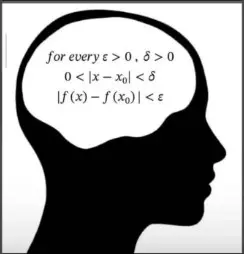
So I tried explaining it without the calculus.
Think of an oven. ε is the amount of error you're willing to tolerate. δ is how precisely you need to control the input to stay within that tolerance. That's essentially the intuition behind the formal definition.
And then I started seeing the programming connections everywhere.
Floating-point calculations deal with tiny errors and rounding differences. Instead of expecting two computed values to be exactly equal, you check whether their difference is small enough: abs(a - b) < EPSILON. Optimization algorithms need stopping conditions. Numerical stability matters because tiny errors can propagate into catastrophic failures.
Suddenly, that definition I had memorized years ago wasn't something to reproduce in an exam. It was a way of thinking about boundaries, tolerances, and conditions.
Explaining it to someone else made me realize something bigger.
A mental operating system
Math isn't just the collection of theorems you remember. It's a mental operating system. It trains you to ask: what exactly are the conditions here? What happens at the boundary? What am I allowed to assume?
That habit follows you into engineering whether you notice it or not.
I started noticing it when I was writing code. Before touching a problem, I started forcing myself to write three things:
- ASSUMES — what must be true for this to work?
- PROMISES — what does this function actually guarantee?
- WILL NOT HANDLE — what is explicitly outside its responsibility?
The third one is where things get interesting. Because "will not handle" is where invisible assumptions finally surface. If I write "this function will not handle duplicate values" — I've made an assumption visible. Now I can challenge it. Either way, I've stopped pretending the assumption doesn't exist.
The dangerous kind of bug
I learned this the hard way with quicksort. I implemented it. It worked. Then I tested it with duplicate values — and it silently dropped them from the output. No error. Just wrong results.
The problem wasn't the line where I noticed the failure. It was the assumption underneath the algorithm: I had assumed the input contained distinct values. The algorithm worked perfectly under that assumption. The problem was I had never acknowledged the assumption existed.
That's the dangerous kind of bug. Not because the code is complicated. Because you don't know what you're assuming.
And this scales far beyond one sorting algorithm.
Think about a system built from multiple services. Service A assumes Service B always returns a value. Service B assumes A will retry on failure. The database assumes requests are idempotent. The frontend assumes the API response always contains the field it needs.
Every component works exactly as designed. The system still fails.
Because the assumptions live between the components — not inside them. That's where most real engineering problems hide. In the gaps.
Outsourcing the thinking
This is also why I don't think AI tools are the problem. Outsourcing the thinking is.
An AI can write the function, suggest the architecture, debug the error. But if you don't know what the system is supposed to assume, promise, or refuse to handle — you can generate perfectly reasonable code for a problem you never actually understood.
I've done this myself. I skipped a hackathon once because I told myself I wasn't ready. The real problem was simpler: I hadn't opened the documentation. I had reached a conclusion before investigating the premise. That's the same mistake in a different outfit.
Eventually I built a contact book from scratch. Five files. Clean structure. Every function deliberately reasoned through before a single line was written. Nothing revolutionary. But it felt different — because I wasn't just asking "how do I make this work?" I was asking "what am I assuming here?"
That shift is the whole game.
The goal isn't to memorize more syntax. It isn't to use fewer tools. It has nothing to do with whether you studied maths, computer science, or something else entirely.
The real question is:
Can you find the broken assumption before you start solving?
That's what maths taught me. Two years after I graduated.
"The room you’re in is already deciding how far you go."
Start a Conversation